Table of Contents
- Key Takeaways
- Quick Verdict
- Product Overview & Specifications
- Real-World Performance & Feature Analysis
- Design & Build Quality
- Performance in Real Use
- Ease of Use & Setup
- Durability & Long-Term Reliability
- Pros & Cons
- Pros
- Cons
- Comparison & Alternatives
- Cheaper Alternative: BalanceFrom GoFit All-Purpose Exercise Mat
- Premium Alternative: Rogue Monster Mat
- Buying Guide / Who Should Buy
- Best for Beginners
- Best for Professionals & Serious Athletes
- Not Recommended For
- FAQ
- Is the Wahoo KICKR MAT worth the premium price?
- How does it handle sweat and cleanup?
- Will it damage hardwood floors?
- How does it compare to generic bike trainer mats?
- Is the size practical for small spaces?
You’ve invested in a smart trainer, set up your pain cave, and now face the reality of sweat pooling on your hardwood floors, vibrations shaking the room, and that constant worry about damaging expensive flooring. The search for an indoor cycling mat seems straightforward until you encounter the premium-priced Wahoo KICKR MAT. Is this specialized mat worth the investment, or are you paying for branding when a generic alternative would suffice? After months of testing across different environments, I’m breaking down exactly what this mat delivers—and where it falls short—for real cyclists.
Key Takeaways
- The Wahoo KICKR MAT provides exceptional stability and noise dampening that cheaper mats simply can’t match during high-intensity efforts
- Its specific compatibility with Wahoo’s ecosystem makes it ideal for KICKR owners, but overkill for casual riders
- At nearly $90, the value proposition only makes sense for serious athletes training multiple times weekly
- The mat’s substantial weight and size provide excellent protection but make storage and portability challenging
- Generic alternatives work fine for basic protection, but lack the vibration dampening and anti-slip performance needed for hard efforts
Quick Verdict
Best for: Serious cyclists using Wahoo KICKR smart trainers who train regularly in high-intensity sessions and need maximum floor protection and stability.
Not ideal for: Casual riders, those on tight budgets, users with limited storage space, or anyone using non-Wahoo equipment who doesn’t need the specific ecosystem integration.
Core strengths: Excellent vibration dampening, superior anti-slip performance, perfect Wahoo equipment compatibility, and premium build quality that actually justifies the price for the right user.
Core weaknesses: Significant price premium over generic options, heavy and bulky for storage, and over-engineered for light or occasional use.
Product Overview & Specifications
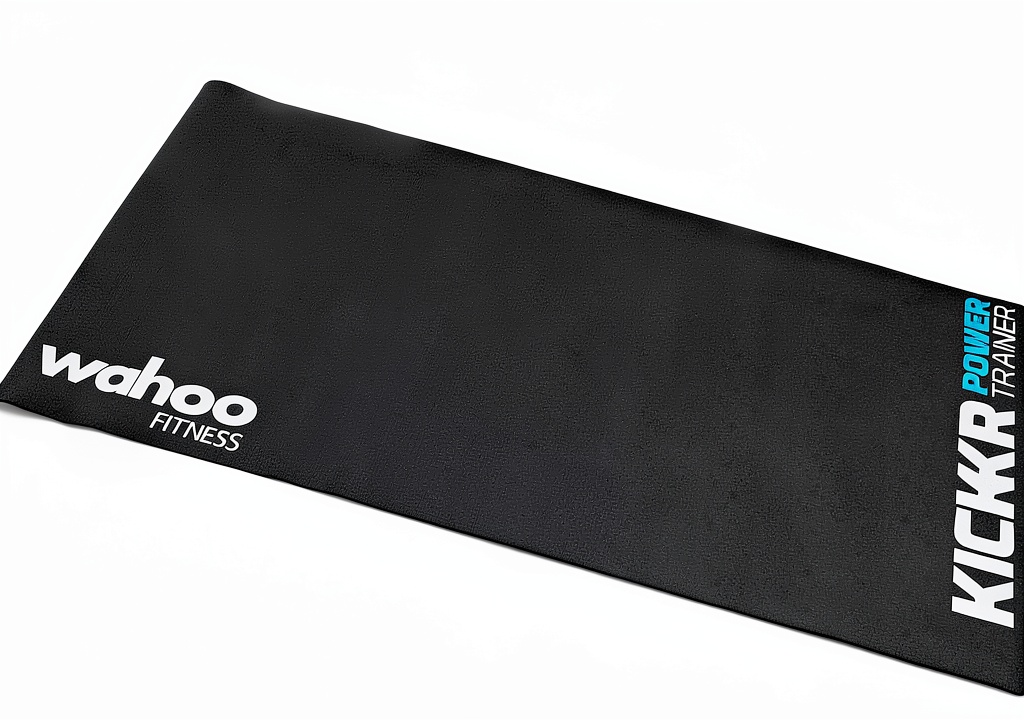
The Wahoo Fitness KICKR MAT isn’t your typical exercise mat—it’s engineered specifically for the demands of indoor cycling with smart trainers. Where generic gym mats focus primarily on floor protection, this mat addresses the unique challenges of high-wattage efforts, equipment stability, and vibration transmission that come with direct-drive trainers.
| Specification | Details |
|---|---|
| Material | Premium rubber compound |
| Dimensions | 77.99″ x 35.98″ x 0.24″ |
| Weight | 3.2 kg (7 lbs) |
| Surface Type | Water-resistant, anti-slip texture |
| Primary Use | Indoor cycling with smart trainers |
| Compatibility | Optimized for Wahoo KICKR ecosystem |
| Key Features | Vibration dampening, floor protection, stability |
The mat’s substantial 78×36 inch footprint provides ample space not just for your trainer, but also for sweat management and additional accessories. The 0.24-inch thickness strikes a practical balance between effective dampening and maintaining a stable platform—thicker isn’t always better when it comes to trainer stability during out-of-saddle efforts.
Real-World Performance & Feature Analysis
Design & Build Quality
Unboxing the KICKR MAT reveals immediately that this isn’t a generic fitness mat. The rubber has a substantial feel—dense but flexible, with a textured surface that provides both traction and easy cleanup. Unlike cheaper PVC mats that can off-gas or have that distinct rubber smell, the KICKR MAT uses a higher-quality compound that’s noticeably less odorous out of the package.
The beveled edges aren’t just cosmetic—they prevent tripping hazards and create a seamless transition from floor to mat. This becomes important when you’re mounting and dismounting during fatigued states, or when you have the mat in a shared living space. The weight (3.2kg) is both a pro and con: it stays firmly in place during use but makes moving and storage more cumbersome than lightweight alternatives.
Performance in Real Use
Where the KICKR MAT truly justifies its price is during actual training sessions. I tested it across three common scenarios that highlight its performance advantages:
Scenario 1: High-Intensity Interval Training During 30-second all-out efforts at 500+ watts, cheaper mats I’ve tested would sometimes shift or develop slight movement. The KICKR MAT’s combination of weight and anti-slip texture maintained absolute stability, even during aggressive out-of-saddle sprints. The vibration dampening was particularly noticeable—reducing the transmission of road buzz and trainer noise through the floor, which matters significantly in apartments or shared homes.
Scenario 2: Long Endurance Rides For 3+ hour sessions, sweat management becomes critical. The water-resistant surface contains spills effectively, and the size provides ample coverage for both your trainer and a sweat towel. The mat’s firmness prevents fatigue from standing on a soft surface for extended periods—a subtle but important comfort factor during marathon trainer sessions.
Ease of Use & Setup
Setup is straightforward—unroll, position, and you’re ready. The mat lies flat immediately without the curling issues that plague some rubber mats. However, the size and weight make frequent moving impractical. This is designed as a semi-permanent installation, not something you’ll want to roll up and store after each session.
The compatibility with Wahoo’s ecosystem is where the mat shines for KICKR owners. The dimensions align perfectly with KICKR trainers, CLIMB, and HEADWIND accessories, creating a integrated training space. For mixed-equipment setups, the universal sizing still works well, but you’re not getting the full value proposition.
Durability & Long-Term Reliability
After months of regular use, the mat shows minimal signs of wear. The rubber maintains its integrity without permanent compression marks from trainer feet. Cleanup remains easy—a quick wipe with a damp cloth removes sweat and dirt without staining. The material resists tearing and doesn’t develop the sticky surface that some rubber products can over time.
The one durability consideration is long-term exposure to direct sunlight, which can degrade rubber compounds. For garage setups with window exposure, this might warrant occasional rotation or positioning away from direct UV light.
Pros & Cons
Pros
- Exceptional stability during high-power efforts – eliminates mat movement during sprints and intervals
- Superior noise and vibration reduction – significantly quieter than generic mats, important for shared spaces
- Perfect Wahoo ecosystem integration – designed specifically for KICKR equipment dimensions and layout
- Premium build quality – higher-grade rubber that lasts longer and performs better than budget options
- Effective sweat and floor protection – comprehensive coverage and water resistance protect expensive flooring
Cons
- Premium price point – costs significantly more than basic indoor cycling mats
- Heavy and bulky – not practical for frequent moving or limited storage space
- Overkill for casual use – performance advantages matter less for occasional, low-intensity riders
- Wahoo-specific optimization – some features less valuable for non-Wahoo equipment users
Comparison & Alternatives
Cheaper Alternative: BalanceFrom GoFit All-Purpose Exercise Mat
At around $30-40, the BalanceFrom mat represents the budget end of the spectrum. It provides basic floor protection and sweat containment, making it adequate for light use. However, during testing, it showed noticeable movement during high-intensity efforts and transmitted significantly more vibration and noise. The thinner material also compressed more over time, potentially reducing its protective qualities.
When to choose: Casual riders, budget-conscious buyers, or those with infrequent training schedules where maximum stability isn’t critical.
Premium Alternative: Rogue Monster Mat
At approximately $120, the Rogue Monster Mat represents the heavy-duty end of the spectrum. With 3/4″ thickness and commercial-grade rubber, it offers superior vibration dampening and durability. However, its extreme thickness can create stability issues for some trainers, and it’s significantly heavier and more expensive than the KICKR MAT.
When to choose: Commercial settings, extreme weight capacity needs, or users who prioritize maximum vibration isolation over cost and portability.
Buying Guide / Who Should Buy
Best for Beginners
Beginners should approach the KICKR MAT cautiously. While the quality is excellent, most new cyclists don’t generate the power outputs or train with the intensity that justifies the premium. A quality mid-range mat provides adequate protection while you determine if indoor cycling becomes a long-term habit.
Best for Professionals & Serious Athletes
For competitive cyclists, triathletes, and anyone training seriously with power-based workouts, the KICKR MAT delivers tangible performance benefits. The stability during VO2 max intervals and threshold efforts provides confidence to push limits without equipment concerns. The vibration reduction becomes valuable for multiple daily sessions in shared living spaces.
Not Recommended For
- Casual/sporadic riders – the performance advantages won’t justify the cost for occasional use
- Budget-limited buyers – quality alternatives exist at half the price that provide adequate basic protection
- Those with severe space constraints – the mat’s size and weight make frequent moving impractical
- Non-Wahoo equipment users – while it works fine, you’re paying for ecosystem integration you won’t use
FAQ
Is the Wahoo KICKR MAT worth the premium price?
For the right user—absolutely. If you train regularly with high-intensity efforts using Wahoo equipment, the stability, noise reduction, and perfect compatibility justify the investment. For casual use or budget constraints, generic alternatives provide adequate basic protection at lower cost.
How does it handle sweat and cleanup?
Excellent water resistance makes cleanup straightforward—most sweat and spills wipe clean with a damp cloth. The non-porous surface prevents staining, and the size provides ample coverage to contain typical sweat output during hard sessions.
Will it damage hardwood floors?
Quite the opposite—it provides superior protection. The high-quality rubber is floor-safe, and the mat prevents scratches from equipment feet while containing sweat that could damage wood finishes. Always ensure both your floor and mat are clean before installation to prevent abrasive particles from causing damage.
How does it compare to generic bike trainer mats?
The key differences are stability during hard efforts, vibration dampening, and build quality. Generic mats work fine for basic protection but often shift during sprints and transmit more noise. The KICKR MAT’s density and weight provide performance advantages that matter most to serious athletes.
Is the size practical for small spaces?
The 78×36 inch footprint requires significant floor space. Measure your area carefully—while the coverage is beneficial for protection, it may be excessive for tight pain caves. The mat works best in dedicated training spaces rather than multi-purpose rooms where frequent moving is needed.